Embark on the Classic Everest Base Camp Tea House Trek in 2026 and explore the most stunning landscapes the Himalayas have to offer. Stay in cozy teahouses along the way, follow an expertly crafted Everest Base Camp Trek Itinerary, and get all the cost details you need to plan your dream adventure today. This trek, one of the most iconic routes in Trekking in Nepal, runs 15 days from arrival to departure.
Completing the Everest Base Camp Tea House Trek is more than a hike it's a lifetime accomplishment and a badge of honor. Imagine standing at the top of the world, so close to the towering giants of the Everest Region Trekking that you can almost reach out and touch them.
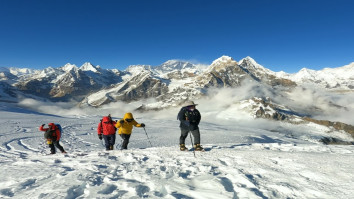
As you make your way through Everest Region Trekking trails, jaw-dropping views of some of the world's highest snow peaks unfold before your eyes Kwangde, Tawache, Lhotse, Nuptse, Ama Dablam, Khantega, and Thamserku. The remarkable sight of Mt Everest rising behind Lhotse and Nuptse is a dream come true for every trekker who makes the journey.
Our trek begins with a scenic 30-minute flight over lush green hills and snow-capped mountains, landing at Lukla's Tenzing-Hillary Airport. The flight itself is an adventure with the vivid green Himalayan landscape below and dazzling white peaks stretching out beside you.
From the Sherpa village of Lukla, the trail follows the Dudh Koshi River, crossing suspension bridges and winding along smooth, well-maintained paths and stone steps down to Phakding village. Along the way, we pass through the small settlements of Benkar, Chumoa, and Monjo, all within the boundaries of Sagarmatha National Park. The trail continues through Jorsale before reaching Namche Bazaar 3440 m, the main trading hub of the region and the true gateway to Mount Everest.
From Namche, the trail leads to Dingboche via the historic Tengboche Monastery, passing numerous stupas, mani walls, and small villages, all set against striking views of Mt. Ama Dablam. An acclimatization hike to Nangkartshang offers close, sweeping views of the towering Himalayan giants that surround the Everest region. Along the trail, you'll pass stone-walled villages, grazing mountain goats, chattering snow cocks, and heavily laden yaks moving unhurriedly along the path.
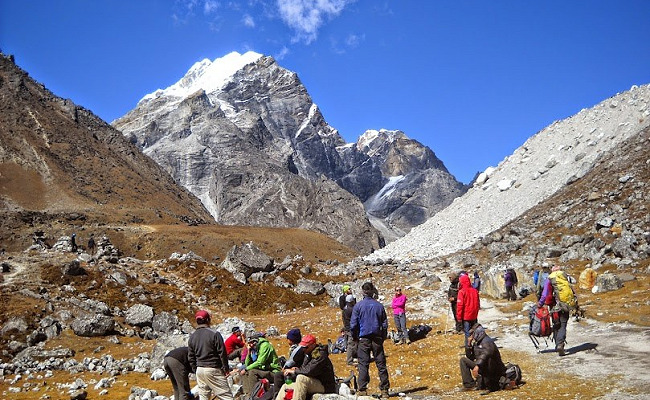
From Dingboche, the route continues to Lobuche and then to Gorak Shep, tracing the moraine alongside the Khumbu Glacier. The 360-degree panorama of snow-white peaks is nothing short of spectacular, with your first glimpse of Kala Patthar the grey-green vantage point beneath Mt. Pumori building anticipation for what's ahead. From Gorak Shep, the trail leads to our final destination: Everest Base Camp Trek itself.
The next morning, we hike up to Kala Patthar to witness sunrise over the Himalayan peaks, with Mt. Everest as the crown jewel of the view. The dramatic vistas as you climb are unforgettable. After soaking in this once-in-a-lifetime moment, we retrace our steps back toward Lukla to complete the journey.
The Nepal Unique Treks team takes you to the top of the world with care and expertise, making your journey both unforgettable and stress-free. Our experienced, friendly guides lead the way throughout, delivering a high standard of service from start to finish. We pride ourselves on being the trekking partner that puts your happiness and safety first.
Teahouses are at the heart of the Everest Base Camp Trek experience, offering trekkers a unique and immersive way to explore the region. Staying in local teahouses is like reading an open book on Sherpa culture the community world-renowned for its mountaineering skill along with local traditions, religion, and the everyday lifestyle of the mountain people.
Throughout the trek, we stay in teahouses run by local Sherpa families and enjoy organic, home-cooked meals each day. Most teahouses have a clean, well-decorated dining hall, comfortable private rooms, and shared toilet and shower facilities. For trekkers looking for something more upscale, several teahouses along the route now offer higher-end accommodation, with service ranging from three-star to five-star comfort depending on your budget.
Reputable teahouse owners limit the number of guests to match their capacity, ensuring clean and comfortable rooms with separate shared toilets and showers. While the food menu is generally simple, organic and homemade dishes are widely available. Most teahouses also offer Wi-Fi and device charging for an additional fee, along with wood-burning fireplaces to keep the dining hall warm in the evenings. Power is typically supplied through local micro-hydro systems, with some teahouses also relying on solar panels.
If you're drawn to the Khumbu but want to go further, the Everest Three High Pass Trek and the Gokyo Valley Trek are excellent extensions or alternatives to the classic route. The Three High Passes Trek takes you over Kongma La Pass 5535 m, Cho La Pass 5420 m, and Renjo La Pass 5360 m for a more challenging, high-altitude circuit, while the Gokyo Valley Trek leads to the stunning turquoise Gokyo Lakes and offers its own spectacular viewpoint at Gokyo Ri 5357 m a fantastic option for trekkers wanting fewer crowds and equally dramatic scenery.
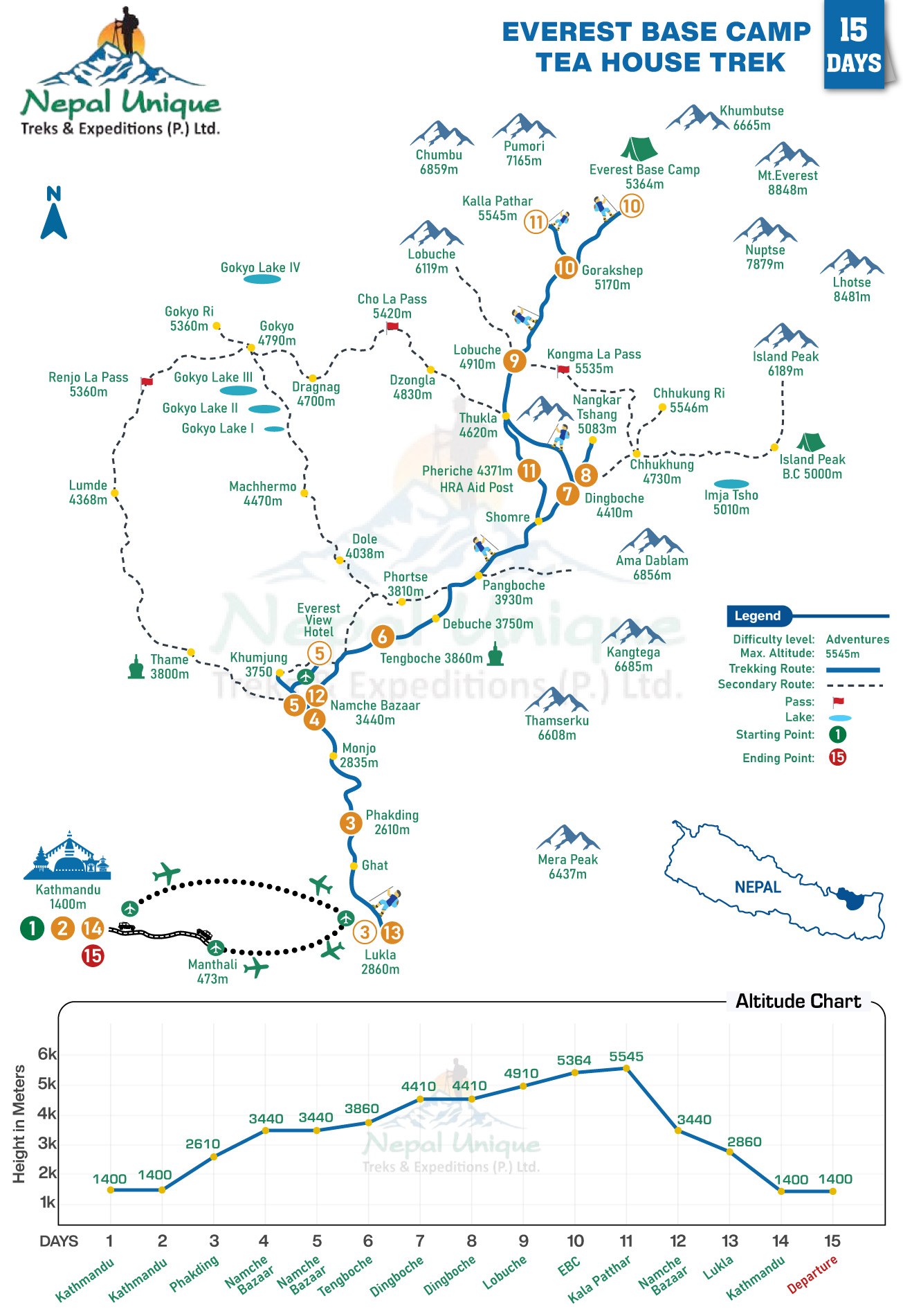
Before you set off, it's worth studying a detailed Everest Base Camp Trek Map to understand the route, elevation gain, and daily stops, so you know what to expect each day on the trail. Pairing this with a well-paced Everest Base Camp Trek Itinerary one that includes proper acclimatization days is key to a safe and enjoyable trek.
As for timing, the best time to trek Everest Base Camp Trek is during the pre-monsoon spring season (March to May) and the post-monsoon autumn season (late September to November). During these months, the weather is generally stable, skies are clear, and mountain views are at their best, making them the most popular and most recommended windows for tackling this iconic Himalayan adventur
Our Team will be waiting for you at Kathmandu International Airport for your Welcome, and ride the car 6.5 km drive to the Hotel. Check-in Hotel and overnight sleep at Thamel.
After breakfast, Meet at the Hotel, complete our agreements for the Everest Base Camp Teahouse Trek, and collect Official documents. 9 am start your day by exploring Kathmandu Valley. Our Tour Guide will introduce you to the Kathmandu Valley and tourist attractions.
Kathmandu Valley starts from Swayambhunath, Bouddhanath, Pashupatinath (Hindu Temple), and Patan Durbar Squire. Our guide will bring you a rooftop restaurant for delicious food with the best view of Kathmandu International Airport and around the valley. Then Early afternoon drive back to the Hotel and take your time to rest.
4 pm, Introduce us to our trekking guide, check the trekking gear list, and manage everything, if not enough clothing or necessary things then we can buy in Thamel. At 6 pm, you will participate in a welcome dinner with a Nepali cultural restaurant, which is hosted by Nepal Unique Treks. Overnight Sleep at Thamel.
2 am, wake and drive from Kathmandu to Ramechhap Manthali Airport, It takes 4 hours and 30 minutes. Take a tea coffee and a 20-minute flight to Lukla Airport. A short and amazing mountain flight will bring you to Lukla airport which is 2850m from sea level. Meeting in Lukla local Sherpa who will help us to carry our duffel bags during the Everest base camp Teahouse Trek.
Trek starts passing by Lukla airport, We will check Trekking permits at the end of Lukla Bazaar. Today we are trekking to Phakding village which lies at 2650m, almost 200m below Lukla, after 3/4 hours walking you will have arrived in Phakding Village. Check-in guesthouse and take time for refresh. In the afternoon visit the Monastery and surrounding Local Villages. Overnight stay in Phakding Village.
Today's trekking leads to Namche Bazaar via Manjo and Jorsalle Village, It takes 6/7 hours and 10km walking, Namche's height is 3440m from sea level, during the trekking passing by some local sherpa villages and crosses a suspension bridge, Most of the trekking trails are uphill about 800m until Namche Bazar.
Breathtaking views during the day, and we can see Thamsherku, Kusung Kangaru, Mt Everest, Nuptse, and Cholatse from Top Dada, also called the first Everest viewpoint, and a surprise view of Namche when you arrive at The Guesthouse. Overnight sleep at Namche Bazaar.
When you are doing high altitude trek Acclimatization is very important to make sure your health and adjust to the mountain climate. After breakfast hike to the Sagarmatha National Park museum and viewpoint, and continuously hike up to the Everest View Hotel, It will be a 3 3-hour day trip.
if you feel ok and still love to explore then continue to the Khumjung village. You may visit the Monastery, Hillary School, and Khunde Hospital, It will be quite a big day. Early afternoon back to Namche Bazaar enjoy the time Documentary show with coffee and shopping in Namche. Overnight sleep at guesthouse.
Today we will trek from Namche to Tengbuche Monastery, It takes approximately 6 hours and during the trekking, we will see amazing views of Mt Everest, Nuptse, Lhotse, Amadablam, Thamsherku, Kwangde, and Cholatse.
from the starting point to Kyangjuma village, we will 2 hours of easy walking, where we will stop for a tea break. Then we will stop for Lunch for another 1 hour and a 30-minute trek to the riverside in (Phunki Thanka). After lunch trek to Tengbuche Monastery via Rhododendron forest. Explore their overnight sleep at Himalaya Lodge.
Early morning we will see a surprise sunrise view from Tengbuche, and slowly mountains are getting bright. The moment will be a very romantic Sunrise with an Everest view. Monks are chanting inside the monastery and they are wishing for everyone to have a successful trek. After breakfast, our trek starts via Pangbuche Village and Samare Village.
During the trek, It will be a fantastic mountain view, we will cross a suspension bridge, have a Tea break in Pangbuche Village, and we will stop for Lunch in Somare Village After having lunch 2 more hours trek will arrive at Dingbuche Village.
Today, we will have a rest day in Dingcuche, Have breakfast in the Guesthouse, then Hiking to Nagarjun Hill for Acclamatazation and enjoy the breathtaking view of Amadablam, Makalu, Island Peak, Thamserku, and Cholatse with Chhukung Valley. It will be a few hours' trip for Acclimatization, Trek back to the Guesthouse and use your time for showering, Laundry, and rest, In the evening time walk around the village and explore the local people's lifestyle in the Mountain.
After breakfast in the Guesthouse, Start trekking from Dingbuche to Lobuche, the scenery is awesome during the day. Today Trekking is more difficult than yesterday trekking from Tengbuche to Dingbuche. because of the higher elevation and less oxygen level.
After 3 hours of walking, you will arrive in Thukla. We will stop there for tea and coffee, After that climb up Lobuche via Thukla Pass, Also known as Monument Places. From Thukla Teashop It takes another 2/3 hours.
Arrived in Lobuche which is 4910m from sea level, also it is the second last village to go to Everest Base Camp. Check in Teashop and take lunch, After lunch visit the Khumbu Glacier. It will be an easy and short Hike also good for acclimatization. Overnight sleep at Teashop in Lobuche.
Early in the morning take a breakfast then start the trek to Everest Base Camp via Gorakshep. Today's trek is longer and harder than other days because Everest Base Camp is the final destination of our Trek. Today we have to walk through Khumbu Glacier which is a rocky trail.
After 3/4 hours walking arrived in Gorakshep, which is the last settlement of the Everest region. we will check in Teahouse and get warm food, After the food, we will move to our final destination, From Gorakshep to Everest Base Camp and back to Gorakshep it will be a roundtrip and it will take another 5 hours to finish the Day.
Today we feel like sick people because of the high High-altitude and low oxygen, most of the trekkers have headaches and are sick from the altitude but still, they like to go and they will do it. After the summit of Everest Base Camp 5364m, they Trek back to Teahouse, they feel proud of themselves, and automatically they feel better than in the daytime, have dinner and warm sleep in Teahouse.
Early Morning at 4 am, Hike up to Kalapathar and enjoy the Sunrise with the Everest Panoramic view, and many other Snowcaped mountain views, then trek back to Gorakshep. After breakfast, trek to Pheriche Village via Lobuche and Thukla, It will be 6/7 hours trek. Overnight stay at Pheriche.
Pheriche to Namche will be the second last trekking day of the Everest Base Camp Trek. today you will walk around 20 km, Today we will start hiking early because 40 minutes later below from the Pheriche we can see a mesmerizing view of the Mountain, If we start late it will be sunny and bright so we cannot take the best photo. also, we have to walk a long way to get to Namche via Pangbuchhe, Tengbuchhe, Phortse Thanga, and Kyangjuma village, It takes about 8/9 hours.
Today is the last day of trekking from Namche to Lukla. It will be some excitement to go back home after many days also you can feel proud of yourselves. After Breakfast start the journey back to Lukla via Jorsalle, Manjo, and Phakding. It will be a memorable last day of Trekking in the Khumbu Himalaya, it will be a 7-hour trek until they arrive at Lukla.
Last day with the Local Sherpa in Lukla, so we will have a party and appreciation to the porter, who carried our baggage during the trek. Sharing trekking experiences and making memorable moments with Sherpa. After dinner sleep at Lukla Guesthouse.
Early in the morning take some tea coffee or breakfast in the Guesthouse, your guide will let you know about the flight time to Ramechhap. Fly to Ramechhap and we will take a 4-hour drive to Kathmandu. Check-in the Hotel and take a rest.
7 pm Nepal Unique Trek will invite you for your farewell dinner, and we will congratulate you on your successful Everest Base Camp Trek, giving you by official certificate.
the Nepal Unique Treks team will drop you at the Airport, 3 Hours before then your International Flight,
Full include and exclude details for this package are coming soon.
Packing the right gear can make all the difference between an enjoyable trek and an uncomfortable one, especially with the wide temperature swings you'll experience across different altitudes. Here's a practical checklist to help you prepare:
Sleeping & Comfort
Health & Hygiene
Your trekking agency Nepal Unique Treks can typically provide a detailed, season-specific packing list once your Everest Base Camp Trek Itinerary is confirmed, and most gear can also be rented or purchased in Kathmandu or Namche Bazaar if needed.
The Everest Base Camp Tea House Trek is rated moderate to challenging. It doesn't require any technical climbing skills or prior mountaineering experience, but it does demand a good level of physical fitness, mental stamina, and proper acclimatization, since the trail spends multiple days above 4,000 meters.
Who it suits: Trekkers with a moderate fitness level who prepare in advance through regular cardio, hiking practice, and some strength training generally complete the trek without major issues. It is a good fit for first-time high-altitude trekkers as long as they take acclimatization seriously and listen to their guide's advice.
For trekkers weighing their options within Everest Region Trekking, the classic Everest Base Camp Trek is generally considered less demanding than the Everest Three High Pass Trek, which involves crossing three passes above 5,300m and is better suited to trekkers with prior high-altitude experience.
The Gokyo Valley Trek falls somewhere in between similar in overall difficulty to Base Camp, with the added challenge of the Gokyo Ri viewpoint climb, but without the high-pass crossings.
If you're new to Trekking in Nepal, it's worth spending a few weeks beforehand on cardio training, stair climbing, or hill walking with a loaded backpack to build the stamina and leg strength this trek demands.
Throughout the Everest Base Camp Tea House Trek, you'll stay in locally run teahouses simple, family-owned lodges that double as the social heart of each village. Rooms are typically twin-share, with a wooden bed frame, a mattress, and blankets, though it's still recommended to bring a good four-season sleeping bag, especially above Namche Bazaar where nights get cold.
Bathrooms are usually shared, with squat or Western-style toilets depending on the teahouse, and hot showers are available in most villages for a small extra fee (often bucket showers or gas-heated at higher altitudes).
Lower down the trail, in villages like Phakding, Namche Bazaar, and Monjo, teahouses tend to be more comfortable, some offering attached bathrooms, better bedding, and reliable Wi-Fi. As you climb higher toward Dingboche, Lobuche, and Gorak Shep, accommodation becomes more basic thinner walls, shared toilets, and simple dining halls but the warmth of a wood-burning stove and a hot meal make up for the modest surroundings.
Meals are typically taken in the teahouse dining hall, which also serves as a gathering place to warm up by the fire and chat with fellow trekkers. Menus are simple but varied, and most teahouses prepare food fresh to order. Popular options include:
Portions are generally generous, and food prices increase gradually with altitude due to the cost of transporting supplies by porter or yak. Bottled water becomes more expensive higher up the trail, so many trekkers carry water purification tablets or a filter and refill from teahouse taps or streams instead. Vegetarian, and to a lesser extent vegan and gluten-free, options are usually available, though it's worth informing your guide of any dietary restrictions in advance.
For hygiene and altitude reasons, it's generally advised to avoid meat dishes at higher elevations, since fresh meat is carried up on long journeys without refrigeration. Sticking to vegetarian meals like dal bhat, vegetable curries, and potato dishes is both the local norm and the safer choice as you climb higher.
Nepal 
Nepal
Nepal
Nepal
Nepal

(51) Reviews
.jpg)
.jpg)
 WhatsApp
 Plan Your Trip




 Reviews 5/5
 Reviews 5/5
 Reviews 5/5