Lower Dolpo trek - 18 Days
Trip Facts
Overview
Lower Dolpo Trek Overview
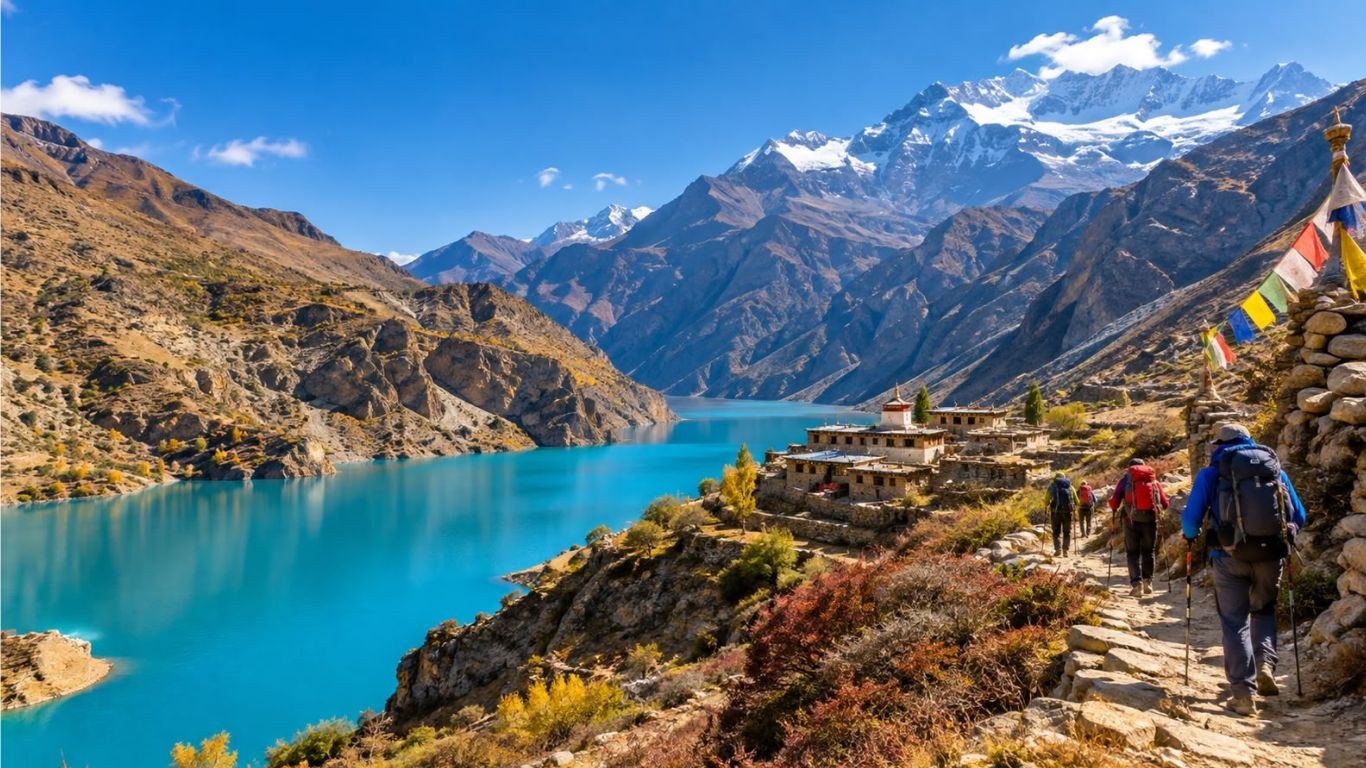
The Lower Dolpo Trek is one of the most fascinating off-the-beaten-path trekking experiences in Nepal, taking adventurous travelers deep into the remote landscapes of western Nepal. Far from the busy trails of the Everest Region Trekking and Annapurna Region Trekking, Lower Dolpo offers a quieter Himalayan experience surrounded by dramatic mountains, deep valleys, ancient villages, Buddhist monasteries, forests, and the spectacular turquoise waters of Phoksundo Lake.
Located within and around Shey-Phoksundo National Park, the trek combines rugged Himalayan scenery with the distinctive culture and traditions of the Dolpo region. The Nepal Tourism Board lists trekking and mountaineering among the park's activities and highlights Phoksundo Lake, traditional villages, monasteries, and the area's rich wildlife and biodiversity.
For travelers looking beyond the classic routes, Lower Dolpo is an excellent choice for trekking in Nepal. It provides a genuine wilderness experience where the journey itself is as important as the destination.
A Journey into Remote Western Nepal
- Lower Dolpo is different from the more developed trekking destinations of Nepal. Trails are quieter, settlements are scattered, and much of the journey passes through remote mountain terrain. The landscape changes dramatically as the trail moves from lower forested valleys toward high alpine terrain.
- A typical Lower Dolpo adventure can include spectacular views of the Himalayan range, pine and juniper forests, rugged cliffs, traditional villages, Buddhist cultural sites, and the unforgettable Phoksundo Lake.
- The region is also known for its diverse wildlife. Shey-Phoksundo National Park is home to species including Himalayan tahr, musk deer, Himalayan black bear, blue sheep, ghoral, marmot, and other Himalayan wildlife. The park also records more than 200 species of birds.
Phoksundo Lake, The Highlight of Lower Dolpo
- One of the greatest attractions of the Lower Dolpo Trek is Phoksundo Lake, famous for its striking blue and turquoise colors and spectacular mountain surroundings.
- The journey to the lake passes through dramatic Himalayan scenery before reaching the traditional settlement of Ringmo and the shores of Phoksundo. The combination of the lake, surrounding cliffs, waterfalls, forests, and traditional architecture creates one of the most memorable landscapes in Nepal.
- For photographers, nature lovers, hikers, and travelers searching for something beyond conventional Himalayan routes, Phoksundo is a major reason to explore Lower Dolpo.
Culture and Traditional Himalayan Life
- Lower Dolpo is not only a mountain adventure; it is also a cultural journey. The region preserves traditional Himalayan lifestyles influenced by Tibetan Buddhism and centuries-old mountain traditions.
- Travelers may encounter traditional villages, Buddhist monasteries, prayer flags, mani walls, chortens, and local communities whose lives remain closely connected to the mountains.
- Compared with heavily visited destinations, the remote nature of Dolpo provides a more intimate opportunity to observe traditional Himalayan culture while traveling responsibly and respectfully.
Trekking in Nepal Beyond the Popular Routes
Nepal is internationally known for destinations such as Everest Region Trekking, Annapurna Region Trekking, Manaslu Circuit Trek, and Mustang Region Trekking. These areas offer spectacular scenery and well-established trekking routes.
Lower Dolpo provides a different experience.
While Everest is famous for its legendary mountain scenery and base camp, Annapurna offers extraordinary landscape diversity, and Manaslu combines dramatic mountains with cultural encounters, Dolpo is particularly attractive to travelers looking for remote trekking in Nepal, wilderness, solitude, and traditional Himalayan communities.
This makes Lower Dolpo an excellent option for experienced hikers who want to explore a less-commercialized side of the country.
Hiking in Nepal: What Makes Lower Dolpo Special?
- For people interested in hiking in Nepal, Lower Dolpo offers more than a simple mountain walk. The trail involves long walking days, significant elevation changes, rugged paths, river crossings, and remote camping areas.
- The trek rewards physical effort with extraordinary scenery and a strong sense of wilderness.
- Unlike short hiking routes around Kathmandu or Pokhara, Lower Dolpo requires careful preparation and logistical planning. Trekkers should be prepared for changing weather, limited facilities, remote locations, and high-altitude conditions.
- A professional trekking guide can make a significant difference by assisting with navigation, accommodation or camping arrangements, local communication, safety, and daily trekking logistics.
Itinerary
Day 1: Arrival in Kathmandu (1,400m/4,593ft)
Upon arrival at Tribhuvan International Airport, a Nepal Unique Treks representative will greet you and transfer you to your hotel in Kathmandu. Depending on your arrival time, take the rest of the day to relax, recover from jet lag, or explore the lively streets of Thamel. In the evening, join your guide for a welcome dinner and a briefing covering the trek route, packing essentials, and what to expect in the restricted Dolpo region.
Day 2: Lower Dolpo Trek Permit Preparation and Kathmandu Sightseeing
Since Dolpo is a restricted area, today is dedicated to finalizing your special trekking permit and Shey Phoksundo National Park entry permit both require processing time and original passport documents. While our team handles the paperwork, enjoy a guided sightseeing tour of Kathmandu's UNESCO World Heritage Sites, such as Swayambhunath (Monkey Temple), Pashupatinath Temple, and Boudhanath Stupa. In the afternoon, do a final gear check and pack for the trek.
Day 3: Flight from Kathmandu (1,400m/4,593ft) to Nepalgunj (150m/492ft)
A short domestic flight (approx. 1 hour) takes you from the hills of Kathmandu down to the subtropical lowlands of Nepalgunj, near the Indian border. This overnight stop positions you for the early morning mountain flight to Dolpo. The drop in altitude and rise in temperature is noticeable a good chance to rest before the trek begins.
Day 4: Flight from Nepalgunj (150m/492ft) to Juphal (2,502m/8,208ft), then Trek to Dunai (2,850m/9,350ft)
An early, scenic mountain flight (around 45 minutes) brings you into Juphal, the gateway airstrip to Dolpo, with views of the Dhaulagiri range along the way. From Juphal, begin trekking on a gently descending trail through terraced fields and pine forest along the Bheri River to Dunai, the district headquarters of Dolpo. Trekking time: approx. 2–3 hours.
Day 5: Trek from Dunai (2,850m/9,350ft) to Tarakot (2,543m/8,343ft)
The trail follows the Bheri River valley westward, passing through small settlements, farmland, and forested sections before reaching Tarakot, home to the historic Sandul Gompa and old fort ruins overlooking the valley. Trekking time: approx. 5–6 hours.
Day 6: Trek from Tarakot (2,543m/8,343ft) to Laini (3,160m/10,367ft)
Today's trail turns north along the Tarap Khola gorge, crossing suspension bridges and narrow cliffside paths through a dramatic, narrowing valley. The scenery becomes progressively wilder and more remote as you gain elevation toward Laini. Trekking time: approx. 6–7 hours.
Day 7: Trek from Laini (3,160m/10,367ft) to Nawarpani (3,545m/11,630ft)
Continue following the Tarap Khola upstream through a steep, forested gorge. This section includes several stream crossings and narrow trail sections cut into cliffs one of the more adventurous stretches of the trek. Nawarpani offers a peaceful riverside camp. Trekking time: approx. 5 hours.
Day 8: Trek from Nawarpani (3,545m/11,630ft) to Dho Tarap (4,090m/13,418ft)
The valley gradually opens up as you leave the gorge behind and enter the high, arid Tarap Valley, your first real taste of Dolpo's trans-Himalayan, Tibetan-style landscape. Dho Tarap is a fascinating settlement inhabited by both Tibetan Buddhist and Bon-po communities, with chortens, prayer flags, and traditional stone houses. Trekking time: approx. 6–7 hours.
Day 9: Acclimatization Day in Dho Tarap (4,090m/13,418ft)
A rest day built in for safe acclimatization before heading higher. Use the day to explore Dho Tarap's Bon and Buddhist gompas, meet local Dolpo-pa herders, and take an optional short acclimatization hike onto the surrounding ridges for mountain views. This is an important day for adjusting to the thinning air before the high passes ahead.
Day 10: Trek from Dho Tarap (4,090m/13,418ft) to Numa La Base Camp (4,440m/14,566ft)
Leaving Dho Tarap, the trail climbs steadily through open, high-altitude grazing pastures where you may spot herds of yak and blue sheep. The landscape becomes increasingly barren and mountainous as you approach the base camp beneath Numa La. Trekking time: approx. 6–7 hours.
Day 11: Trek from Numa La Base Camp (4,440m/14,566ft) to Penung Tang (4,465m/14,648ft) via Numa La Pass (5,190m/17,027ft)
One of the toughest and most rewarding days of the trek. A steep, sustained climb leads to the top of Numa La, the trek's high point, where sweeping panoramas of Mt. Dhaulagiri, Norbung Kang, and Churen Himal unfold across the barren Dolpo landscape. After time at the summit for photos, descend along the Gyambo Khola to camp at Penung Tang. Trekking time: approx. 6–7 hours.
Day 12: Trek from Penung Tang (4,465m/14,648ft) to Dajok Tang (4,080m/13,385ft) via Baga La Pass (5,070m/16,633ft)
A second high-altitude crossing, Baga La rewards climbers with stunning views of Mt. Kanjiroba and the surrounding snow peaks. From the pass, the trail descends into greener terrain, gradually easing as you approach Dajok Tang. Trekking time: approx. 6 hours.
Day 13: Trek from Dajok Tang (4,080m/13,385ft) to Ringmo (3,600m/11,811ft)
A comparatively shorter and easier day, descending through pine, cypress, and juniper forest with views of dramatic cliffs and waterfalls. Ringmo is a traditional Bon-po village and the gateway to Phoksundo Lake. Trekking time: approx. 3–4 hours.
Day 14: Trek from Ringmo (3,600m/11,811ft) to Phoksundo Lake (3,611m/11,847ft)
A short, gentle day exploring the area around the stunning turquoise waters of Phoksundo Lake, Nepal's deepest lake and the centerpiece of Shey Phoksundo National Park. Visit the lakeshore, the dramatic Phoksundo waterfall (one of Nepal's highest), and the ancient Bon monastery above Ringmo village.
Day 15: Trek from Phoksundo Lake (3,611m/11,847ft) to Shyanta (2,520m/8,267ft)
Begin the return journey, descending along the Phoksundo Khola through changing vegetation zones from alpine terrain back into pine and fir forest with the trail hugging dramatic river gorges and cliffs. Trekking time: approx. 5–6 hours.
Day 16: Trek from Shyanta (2,520m/8,267ft) to Juphal (2,320m/7,611ft)
The final trekking day follows the Suli Gad and Bheri river valleys back through familiar lower-altitude villages and terraced farmland to Juphal, completing the loop back to the airstrip. Trekking time: approx. 4–5 hours.
Day 17: Flight from Juphal (2,320m/7,611ft) to Nepalgunj (150m/492ft), then Kathmandu (1,400m/4,593ft)
An early morning flight takes you from Juphal back to Nepalgunj, connecting onward the same day to Kathmandu. Enjoy a hot shower, a good meal, and some well-earned rest back in the capital. A farewell dinner in the evening is a great way to celebrate the completed trek.
Day 18: Final Departure
Depending on your international flight schedule, enjoy some free time for last-minute shopping in Thamel or relaxation before our representative transfers you to Tribhuvan International Airport for your departure flight.