Everest Expedition in Nepal
Trip Facts
Overview
One of Nepal's greatest and most adventurous mountaineering journeys is the Everest Expedition.
Summit one of the largest mountain peaks in the world, Mt. Everest.
Visit one of the largest gompas of the Khumbu Region, Tengboche Monastery.
Explore the diversified rare flora and fauna en route.
Immerse yourself in the culture and religions of the local people.
Witness the Khumbu Icefall and walk on the glaciers.
Stay in traditional Sherpa villages en route.
Experience breathtaking Himalayan vistas from multiple viewpoints.
Everest Expedition Overview
Join Nepal Unique Treks for the ultimate adventure with our Everest Expedition in Nepal. Conquer the world's highest snow peak with expert guides. Check out the Everest Expedition in Nepal, Cost, and 62 Days Itinerary for 2025/26. Embarking on an Everest expedition is a life-changing adventure. From the moment you step onto the rugged terrain, the world’s highest peak captivates you. Moreover, this isn’t just a trek, it’s a challenge that demands resilience, strength, and determination. So, if you seek a journey that pushes your limits and rewards you with unforgettable experiences, continue reading to learn what awaits.
The journey will lead you through the Khumbu Valley, where we'll encounter Sherpa villages filled with warmth and a rich cultural heritage. As we ascend, you’ll witness the towering peaks of the Himalayas growing ever closer. Furthermore, each day brings new challenges and moments of awe, from crossing mountain passes to gazing at Everest's majestic summit. In addition, we’ll be immersed in a spiritual experience, surrounded by Buddhist monasteries and vibrant prayer flags fluttering in the mountain breeze.
A standout feature of the trek is the Tengboche Monastery, located amidst the stunning Himalayas. This peaceful sanctuary is not only a religious hub but also an architectural marvel. In addition, we can enjoy panoramic views of Everest, adding a deep sense of serenity to your journey.
The region’s natural beauty is simply breathtaking. Rhododendron forests, alpine meadows, and snow-covered landscapes paint the perfect backdrop. As we trek, keep an eye out for the region’s wildlife, such as the elusive snow leopard and colorful pheasants. Likewise, the flora and fauna offer a unique experience that complements the grandeur of the mountains.
The Everest Expedition is more than a trek; it’s a transformative journey that will challenge, inspire, and leave you with lifelong memories. Ready to take on the adventure of a lifetime? Read on to start planning your trip to Everest’s summit.
Why choose Nepali Unique Treks for this trek?
At Nepali Unique Treks, we don’t just guide you through the mountains, we craft a journey filled with adventure, culture, and unforgettable experiences. In addition, we have over two decades of expertise and specialize in creating seamless, hassle-free treks that immerse you in the true essence of the Himalayas.
Expert Guidance with Local Insights
Our government-certified guides aren’t just experts in high-altitude trekking, they are storytellers, cultural ambassadors, and mountain navigators. Moreover, our guides have years of experience on these rugged trails. In addition, they ensure your safety while sharing hidden gems, local traditions, and fascinating Himalayan folklore. Whether you need help tackling steep ascents, acclimatizing properly, or understanding the region’s customs, our guides are by your side every step of the way.
Tailored Itineraries for Every Trekker
Whether you want extra acclimatization days, seek out lesser-known trails, or adjust your journey based on personal preferences, we customize your itinerary accordingly. Our flexible approach ensures you get the perfect mix of adventure, cultural immersion, and well-paced trekking, making every moment count.
Seamless Logistics, Maximum Comfort
From securing permits to booking the best available lodges and meals, we handle every detail so you can focus on the journey, not the logistics. Moreover, our carefully selected tea houses provide warm hospitality in the heart of the Himalayas, ensuring comfort after long trekking days. Furthermore, with our strong local connections, we offer an authentic, stress-free experience that lets you fully enjoy Nepal’s natural beauty.
With Nepali Unique Treks, your Himalayan adventure is more than just a trek, it’s a story waiting to be lived. Let us take you beyond the trails into the heart of Nepal’s breathtaking landscapes and rich traditions.
Permits required for Everest Expedition
Trekking through the Himalayas isn’t just about breathtaking landscapes and thrilling adventure. We also require the right permits to ensure a smooth and hassle-free journey. Since parts of the route pass through protected areas, obtaining these permits is mandatory. Moreover, besides granting access, they also help authorities track trekkers for safety and support conservation efforts.
For the Everest Expedition, you’ll need the following permits:
Sagarmatha National Park Entry Permit
Khumbu Pasang Lhamu Municipality Entry Permit
Nepal Mountaineering Royalty Fee for Mt. Everest
Trekker’s Information Management System (TIMS) Permit
Sagarmatha National Park Entry Permit
The Sagarmatha National Park, a UNESCO World Heritage Site, is home to rare wildlife, dramatic glaciers, and stunning landscapes. To protect this pristine region, all trekkers are required to obtain a Sagarmatha National Park Entry Permit before entering. Checkpoints along the trail verify permits, ensuring conservation while allowing you to explore the region’s beauty.
Khumbu Pasang Lhamu Municipality Entry Permit
To support local communities and infrastructure development, the Khumbu Pasang Lhamu Municipality requires trekkers to obtain a separate entry permit. The fees collected directly fund trail maintenance, village development, and emergency services, ensuring the sustainability of trekking in the Everest region.
Nepal Mountaineering Royalty Fee for Mt. Everest
The Nepal Mountaineering Royalty Fee for Mt. Everest is required to regulate climbers, manage overcrowding, and support environmental conservation. It helps fund safety measures, rescue operations, and local communities while preserving the mountain’s fragile ecosystem.
TIMS (Trekker’s Information Management System) Permit
Issued by Nepal’s tourism authorities, the TIMS Permit is essential for tracking trekkers in remote regions. This system helps ensure safety by maintaining trekker records, allowing rescue teams to quickly locate travelers in case of emergencies.
At Nepali Unique Treks, we handle all the permit formalities so you can focus on preparing for the adventure ahead. Our team ensures a hassle-free process, giving you more time to enjoy the journey and conquer your Everest dream.
Why is Insurance necessary for the Everest Expedition?
The Everest Expedition is not just a trek, it’s a high-altitude adventure that comes with unpredictable challenges. From harsh weather conditions to altitude sickness and remote terrains, the risks are real. That’s why comprehensive travel insurance isn’t just recommended; it’s essential.
Emergency Evacuation and Medical Coverage
At extreme altitudes, even minor health issues can turn serious quickly. Moreover, altitude sickness, frostbite, injuries, or sudden illness can require immediate medical attention. Furthermore, in severe cases, the only option is an emergency helicopter evacuation, which can cost thousands of dollars. Without insurance, these expenses must be paid out of pocket.
Trip Cancellations and Delays
The weather in the Himalayas is highly unpredictable. Sudden storms, heavy snowfall, or flight cancellations from Lukla to Kathmandu can disrupt your plans. Insurance helps cover financial losses due to trip cancellations, delays, or interruptions, ensuring you don’t lose your investment.
Lost, Stolen, or Damaged Gear
Your trekking gear is critical for survival in the mountains. If your baggage gets lost, stolen, or damaged, replacing essential equipment at high altitudes can be challenging and expensive. A good insurance policy covers lost or delayed baggage, so you’re not left stranded without the necessary gear.
High-Altitude Rescue and Repatriation
In life-threatening situations, rescue teams may need to evacuate trekkers from remote Himalayan locations. Without insurance, the cost of helicopter rescues, medical evacuations, and repatriation can be overwhelming. Having proper coverage ensures immediate response without financial stress.
At Nepali Unique Treks, we strongly advise every trekker to have comprehensive insurance before starting the Everest Expedition. While we ensure your journey is safe and well-planned. However, insurance gives you peace of mind, knowing you’re financially protected in case of unexpected events.
Itinerary
Day 1: Arrival in Kathmandu and Transfer to Hotel
Welcome to Nepal! It's just the beginning of a long journey to the top of the world, Mount Everest (8848 meters). As you land at the Tribhuwan International Airport (Kathmandu), you will meet our local representatives waiting to welcome you. They will greet you with Khada and flower bouquets. After that, our local representatives will drive you to the hotel in a private vehicle. As you reach the hotel, the staff welcomes you with a refreshing welcome drink before you check in at your respective rooms.
Take your time to freshen up yourself, and store your belongings before taking a quick stroll of the nearby areas. As we will be staying in Thamel, you will find different restaurants, cafes, spas, and massage centers to relax before the adventure. In the evening, we invite you for a fulfilling and delicious dinner. Here you will be served with a local Nepali Thakali Khana Set. After that, you can go to your room and relax.
Day 2: Official Formalities, Expedition Preparation, and Kathmandu Tour
This is the day when we prepare for the long-awaited expedition to the summit of Mount Everest. As you wake up and have breakfast, our representatives will bring you the ultimate Everest Expedition permits. After that, you will meet the official guides who will check your gear and all that needs to be included. Just imagine using those gear and equipment while making your way to the highest peak of the world, doesn't that sound amazing? By midday, you’re briefed, bonded with your Sherpa team, and ready to chase 8,848 meters of glory.
In the afternoon, we will take you for a quick stroll in Kathmandu. Take your time to walk through the bustling and hustling narrow roads of the city, crossing through traffic, and watching people do their regular chores. Basantapur Durbar Square and Swayambhunath Stupa stand as the major highlights of the day. Also, do not miss to try some authentic Nepali dishes while exploring the city.
In the evening, we will return to the hotel for dinner and an overnight stay before moving forward in the Everest Expedition journey.
Day 3: Drive from Kathmandu to Ramechhap - 5 hours and Fly from Manthali Airport to Lukla (Tenzing and Hilary Airport) - 20 minutes and Trek to Phakding (2610 meters)
It's finally the beginning of the actual journey towards Mount Everest. After you have a fulfilling and delicious breakfast in the hotel, our representatives pick you up and drive you to the bus station. From there, you will board the bus that drives towards Ramechhap. Driving to Ramechhap from Kathmandu requires us to cover a distance of 141.6 kilometers, which takes approximately 5 hours. Believe us, this will be one of the best drives of your life. Passing through the winding mountain roads, lush hillsides, and amazingly-settled villages and towns.
As you reach Ramechhap, the guides will board you on a 20-minute flight to Tenzing and Hilary Airport (Lukla). The plane soars above the Himalayas, hills, and scenic cities and villages. As you land in Lukla, the Sherpa guides from Nepal Unique Treks take you on a trek towards Phakding. The trail from Lukla to Phakding is known to be the easiest and most convenient trail throughout the entire Everest Expedition journey.
The trail descends through pine forests, crossing suspension bridges draped with prayer flags and passing charming Sherpa villages along the Dudh Koshi River. We will reach the hotel (Phakding) in the late afternoon
Day 4: Trek from Phakding to Namche Bazaar (3,444 meters) - 6 to 7 hours
Are you ready to feel the crusty Himalayan soil below your trekking boots? On the fourth day, we will be ascending to one of the most anticipated towns of the Khumbu region, Namche Bazaar. Located at an altitude of 3,444 meters above sea level. Famous as the Gateway to Everest and the trading hub of Nepal, Namche Bazaar stands as one of the most amazing places in the entire Khumbu region. Other than that, the place also offers everyone a deep insight into the Sherpa culture.
From Phakding, we will follow a rugged, soul-stirring climb that tests your legs and rewards your spirit. However, the starting phase of this section of the Everest expedition follows a gentle trail beside the Dudh Koshi River. Besides, we will also walk through pine forests and past Mani stones etched with Buddhist prayers. On your way to Namche Bazaar from Phakding, the trail goes past several smaller settlements, including Tok Tok, Benkar, and Monjo. After leaving Monjo, we gradually ascend to Jorsalle, the last village before Namche. Remember that the final step of this Everest Expedition or Everest Region Trek goes up through a zigzag rocky path. Therefore, you might feel the air getting thinner as we cross the altitude of 3000 meters.
As you reach Namche Bazaar, you will find yourself in a bustling village where stone houses cling to steep slopes, prayer flags flutter in the crisp Himalayan breeze, and the air carries the faint scent of yak butter tea. If we reach here on Saturdays, this place also hosts a huge market. We recommend the climbers utilize the rest of the day to stroll around the town. In the evening, the hotel serves you one of the most delicious high-altitude dinners and a night of cozy sleep.
Day 5: Rest Day at Namche Bazaar with Quick Hike to the Everest View Hotel
Do you believe that you are waking up at an altitude of 3,444 meters above sea level? Well, that's a lot of altitude to gain within 4 days. However, our destination is 8848 meters above sea level. To keep yourself strong and kicking on, you will need some acclimatization or rest day. Therefore, we will stay back for acclimatization on the fifth day. Wake up in the serenity of Namche Bazaar, have your breakfast, and then go for a quick stroll.
After that, our guides will take you on a short hike to the Everest View Hotel. Located at an altitude of 3880 meters above sea level, this hotel stands as a world-renowned spot offering uninterrupted, panoramic views of Mount Everest, Lhotse, Ama Dablam, and Thamserku. We begin the hike with a steep but rewarding climb above Namche, walking past pristine pine forests and yak pastures. After walking for about 1.5 to 2 hours, we will finally reach the Everest View Hotel, where you can take a sip of tea or coffee while enjoying the views.
On the way back to Namche Bazaar from the hotel, the guides will also take you to the Khumjung Village (3790 meters), one of the most traditional and cultural villages in the Khumbu region. Here, the climbers can visit the Hillary School and stop by the Khumjung Monastery, the home to the legendary Yeti Skull. As you finally reach Namche Bazaar, utilize the rest of the time to stroll around the town, visit different cafes and bakeries, and interact with the locals.
Day 6: Ascend from Namche Bazaar to Tengboche (3,860 meters) - 4 hours
Early morning on the sixth day, the climbers will leave Namche Bazaar and move their legs towards Tengboche. Located at an altitude of 3860 meters above sea level, Tengboche is the epicenter of peace, calmness, and religious vibes of the Everest trekking region. The name comes from the oldest and the largest monastery in the entire Khumbu region, the Tengboche Monastery. Due to that reason, you will find this place very peaceful and all the chores of locals are highly influenced by religion.
Talking about the route, this section of the Everest expedition starts with a gentle and picturesque walk. On your way, you can also get amazing views of different mountains, including Everest, Ama Dablam, Lhotse, and Nuptse. Other than that, you will walk past some smaller Sherpa settlements as always throughout this trail. After a few hours of walking, the trail dips down through a beautiful pine and rhododendron forest, leading to the Imja Khola River at Phunki Tenga (3,250m). We will stop here for lunch and a short break after crossing a suspension bridge.
The trail from Phunki Tenga to Tengboche is considered to be the most difficult one as the trekkers need to go for a 600-meter steep ascend. The ascent goes through lush pine forests and offers jaw-dropping 360-degree views of the mountains and the valley. Finally, as you reach Tengboche, we recommend the trekkers visit the monastery and witness the prayer ceremonies performed by the monks. While doing that, you can also enjoy a pristine backdrop of the mystical Ama Dablam.
Day 7: Trek from Tengboche to Dingboche (4,410 meters) - 4 hours
Another day awaits another adventurous journey in the 62-Day Everest Expedition. As you wake up and have your breakfast, the Sherpa guides will lead you on a trail that leaves the lush forests and enters the rugged, high-altitude terrain of the Himalayas. The starting section of the journey goes through a gentle descent through rhododendrons and juniper forests, where you will pass through small Mani walls and shorten. After half an hour of walking, we will arrive at Deboche, a small village famous for its nunnery. Here, the travelers need to cross Imja Khola over a suspension bridge, another highlight of the seventh day of the Everest expedition.
From there, we will go for a steady uphill walk to Pangboche (3985 meters), known to be the highest permanent Sherpa village. This village is also famous for having a monastery, the Pangboche Monastery. Beyond Pangboche, the landscape starts to change. We transit from lush forests to barren hills and alpine terrain, marking your arrival into the true Himalayan wilderness. Please stay cautious of the possibility of altitude sickness as we are at an altitude of 4410 meters above sea level.
In Pangboche, we will go for a short break and have lunch before heading towards the final stretch to Dingboche. Dingboche, also known as the Gateway to High Altitudes, sits in the lap of the Himalayas as a popular acclimatization stop for Everest explorers. Just imagine spending a day in a village surrounded by three big mountains: Ama Dablam, Makalu, and Lhotse. Doesn't that sound amazing? Well, it will be more amazing when you stay there the next day.
Day 8: Acclimatization Day at Dingboche and Quick Hike to Pheriche
On the eighth day, we will not ascend any higher in the regular Everest expedition trail. Instead, it will be an acclimatization break for the trekkers to adapt to the higher altitude. Moreover, this will also be a day of side hikes. As you have your breakfast in the hotel and get yourself all ready, the guides will first take you on a quick hike to Pheriche (4371 meters). Let us tell you that, at this altitude, the oxygen level is about 50% of the sea level, making it necessary to gradually adapt to avoid altitude sickness. Therefore, we follow the famous "climb high, sleep low" theory on this day to adapt to the conditions at higher altitudes.
It takes about 2 to 4 hours for us to complete the hike to Pheriche and after that,t we will return to Dingboche again. Upon your arrival in Dingboche, you are free to explore the entire village, interact with the locals, and collect as many memories as possible. Furthermore, we also recommend you try some locally prepared dishes as you walk around. In the evening, you will return to the hotel, have your dinner, and sleep.
Day 9: Trek from Dingboche to Lobuche (4,940 meters) - 6 hours
Today’s journey takes you into the high-altitude wilderness of the Khumbu region, where the landscape becomes rugged and dramatic. Furthermore, this day also brings us very close to the Everest Base Camp. Our walk on the ninth day starts with a gradual and partly gentle ascend to Dughla (2.5 hours). Besides, you can also see Ama Dablam, Taboche, and Cholatse watching you as you struggle higher on the ascent.
In the higher altitudes, you can notice that vegetation becomes scarce along with the settlement and population. In Dughla, we will take a short break and have some lunch. Continuing the trail, the trekkers need to ascend on a 45-minute-long climb. At the end of this climb, you will witness a sacred memorial site dedicated to mountaineers who lost their lives on Everest.
The guides from Nepal Unique Treks and Expeditions will make your walk a little less burdensome as they keep interacting with you. While on this trial, you will also get a chance to walk on a trail that follows the moraine ridge of the Khumbu glacier. After crossing that trail, we arrive in a small village with very few tea houses, Lobuche. This is where the trekkers have dinner and spend the night before walking further on the Everest Expedition trail.
Day 10: Ascend from Lobuche to Gorakshep (5,180 meters) and Hike to EBC (5,364 meters) - 2 hours
Finally, it's the day when we reach the last settlement of the entire Khumbu region. Moreover, it is also the last place from where one can take a helicopter flight. It is none other than Gorakshep. Located at an altitude of 5180 meters above sea level, Gorakshep is known to be the final stay before the most anticipated hike to the Everest Base Camp.
After having breakfast in Lobuche, Nepal Unique Treks' guides lead you to Gorakshep. From there, we will go for a 2-hour hike to the Everest Base Camp. Even though we walk only for 2 hours, the trail is very steep, rocky, and risky. Therefore, we recommend that trekkers be very careful and listen and implement all the information passed on by the guides.
Once you reach the Everest Base Camp, you will feel like stepping into an alien world. High mountains everywhere you see, thick ice everywhere you step, and colorful tents in most of the area; this is what EBC looks like. Take your time to explore the base camp until our Sherpa guides settle a tent for your stay in the Everest Base Camp. After that, you can have your dinner and sleep in the tent.
Day 11: 55: Mount Everest (8,848 meters) Expedition
Finally, we are on the most challenging, intense, and thrilling part of the entire Everest Expedition journey. This is where the climbers need to show full mental endurance, strategic acclimatization, teamwork, and patience. So, be prepared with all your equipment and gear to make your way to the top of the world. Over the next 44 days, you will walk past glaciers, crevasses, and icefalls, battle extreme altitudes and unpredictable weather, and witness some of the most breathtaking landscapes on Earth.
However, remember that this highest peak in the world does not ascend in a single push. Therefore, the Sherpa guides from Nepal Unique Treks and Expeditions take you slowly. Moreover, we will also take breaks at different camps set up by the Sherpas before finally summiting the highest peak in the world, Mount Everest (8848 meters). Let us give you a thorough walk-through of different parts of the Everest Summit from and to the Everest Base Camp.
Day 12: to 15: Final Preparation at Everest Base Camp
Even though the summit expedition is done between the 11th and the 55th day, we will certainly not start the walk right away. The first 5 days will be spent on training, practicing, and preparing for the summit climb. Here, the Sherpa guides will set up tents which will be your home at such a high altitude. After that, we will go for:
Icefall Training: Ladder Crossing, Rope Walk, and Crevasse Navigation.
Acclimatization Climbs: Short hikes to nearby high-altitude areas to go for the "climb high sleep low" technique of ascending to higher altitude.
Final Gear Checks: Ensuring oxygen systems, crampons, and harnesses are in perfect condition.
Day 13: Rotation Climbs for Acclimatization
As mentioned above, we will not climb Everest in a single go. Due to that reason, the Sherpa guides take you on a rotation climb on the Everest Summit climbing trail. Remember that, between these days, you will gradually ascend and descend multiple times. This will help you adapt to the weather and climatic conditions at the higher altitude and prepare you physically and mentally to ascend to the top of Mount Everest. We will go for three different rotations within these days and reach the third camp of the Everest Expedition Trail.
Here's a breakdown:
Rotation 1: Climbing to Camp I (6,065 meters) and back
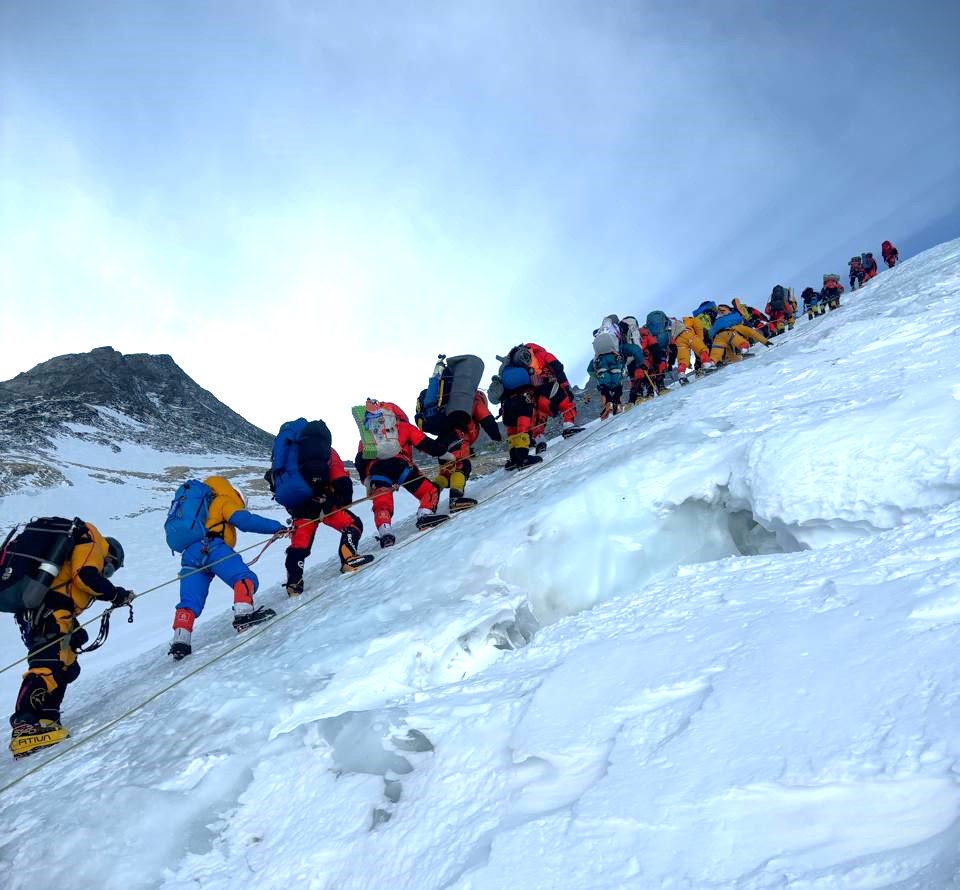
We begin the first rotation before the dawn arrives. It will be an early morning ascending journey, so we recommend the climbers get their headlamps and trekking poles ready. The trail takes us through the Khumbu Icefall, ca constantly shifting maze of massive ice blocks, deep crevasses, and vertical ice walls. Remember that, you will also need aluminum ladders and fixed ropes to cross this section of the Everest Expedition route as we need to cross fragile ice bridges and deep chasms.
Within about 6 to 8 hours of walking, we will finally reach Everest Camp 1. Here, you will be standing on a vast snow-covered plateau, which will certainly be one of the best experiences on this trail now. The guides will set up camp for you to have dinner and spend a night before returning to the base camp.
Rotation 2: Climb to Camp II (6,400 meters) and Back
After spending another night in the base camp, we will go for the second rotation. This amusing climb takes us past the first camp and into the Western Cwm. Western Cwm, also referred to as the Valley of Silence, is a large flat, glacial valley basin located at the base of Mount Everest. Located at an altitude of 6,400 meters above sea level, this is a relatively safe and comfortable camp with insulated tents and a kitchen tent.
From the second camp, the climbers can expect the most unobstructed views of the sky touching Mount Everest, Lhotse, and Nuptse. Take your time to check out the surrounding environment, play with ice, have a proper dinner, and sleep in the second camp of the Everest Expedition trail. After resting here, we will return to the Base Camp before setting off on the next phase of the climb.
Rotation 3: Climb to Camp III (7,162 meters) and Back
It's time to ascend on the face of Mount Lhotse towards a sheer glistering wall of ice, making your way through the thick layer of snow. The Sherpa guides will help you navigate through the best of the ways. In the third Rotation of the Everest Expedition route, we will ascend from the Base Camp to Camp III, located at an altitude of 7,162 meters above sea level. Again, get ready with all the expedition gear and equipment because you will require them the most.
With fixed ropes taut in your gloved hands and an ice axe biting into the frozen surface, every step tests your strength. Be strong, both mentally and physically, listen to the guides, and make sure to remain in the allocated trail. Guided by the Nepal Unique Treks and Expeditions' professional Sherpa climbers, you reach the third camp, a windswept outpost carved into the Lhotse Wall. At this altitude, many climbers require oxygen supplements as the altitude is very high, which makes the air very thin. Therefore, we recommend the climbers to take proper rest.
Imagine spending a night in a camp where you only hear the sound of wind blowing, ice creaking, and your lungs taking in as much oxygen as possible. This will certainly be something an adventurous climber would love to experience. After this vital acclimatization, we will return to the base camp before making the final leap to the Everest summit (8848 meters).
Day 14: The Final Push to the Mount Everest Peak (8,848 meters)
Finally, after so many weeks of constant rotation from camp to camp, your body is ready to ascend to the peak of Everest. Well, this will be the most challenging, thrilling, and difficult section of the entire journey. This critical stage demands precision, favorable weather conditions, and unwavering determination as you push beyond your physical and mental limits to reach the highest point on Earth.
The push towards the Everest summit begins with a direct climb from Base Camp to Camp II, which you have already been to. Here, the climbers will spend a night, and acclimatize for the upcoming ascent towards Camp 3 (7.162 meters). To reach the third camp, the climbers need to walk over the almost vertical ice wall with a firm and less treacherous surface. Just like in the rotation route, you need to start using supplemental oxygen, a vital lifeline for high-altitude adventure.
After spending another night in Camp III, the walk continues towards the fourth and the last camp before the summit. Remember that, this is also known as the "death zone" of Mount Everest due to the extreme weather and climatic conditions. Situated at an altitude of 7,950 meters above sea level, the survival of climbers completely depends upon the careful pacing and efficient use of oxygen. Moreover, we also recommend the climbers remember that this section of the Everest expedition requires an extreme level of physical and mental strength. Besides, the climbers also have to walk past an exceptionally demanding trail, freezing winds, and crushing exhaustion. Camp 4, perched on the South Col, offers a final place of rest before the ultimate challenge.
Now that you have come so high on the mountains and have just a little to conquer the Everest peak, why not take a short break before the final leap? Yes, we will rest for a while in the fourth camp before making the final push towards Mount Everest's Summit (8848 meters).
Day 15: Descent to the Base Camp and Celebration
Summiting the peak of Mount Everest, located at an altitude of 8848 meters above sea level, is certainly an achievement on its own. We know that you enjoyed ascending to the peak of the world and watching the world from such a height. However, let us remind you that the descending journey is also as equally challenging and critical. Therefore, we need to set off toward the base camp with total precaution and sheer endurance. We recommend the climbers.
However, the goal will be to escape the brutal conditions of the Death Zone as quickly as possible, making our way from Camp 4 to Camp 2, before finally returning to Base Camp. Stepping on the base camp after 44 days of brutal expedition gives you a feeling of complete relief. It's your time to celebrate, cheer, and congratulate each other at the Everest Base Camp before returning. Other than that, we also recommend you rest properly and immerse in the feeling of completion. At night, the Sherpa guides will prepare your food and then you will sleep in the camp.
Day 16: Cleaning Base Camp and Preparation before Descending to Gorakshep
Let us remind you that Nepal Unique Treks and Expeditions has established itself as a travel agency that promotes sustainable and environment-friendly tourism. Due to that reason, we make sure that all the trekking routes and destinations are properly cleaned before returning from the journey. Therefore, on the 56th day, we will clean the base camp, before we leave and continue the descending walk towards Kathmandu.
After you clean the base camp with the help of the Nepal Unique Treks and Expeditions' representatives, we will set off on a descending journey towards Gorakshep. Remember Gorakshep, the last settlement before EBC? Yes, that's where we will reach today. It takes a few hours for us to reach Gorakshep, where you will have dinner and go for a comfortable and cozy sleep after so many days.
Day 17: Early Morning Hike from Gorakshep to Kalapatthar (5,550 meters) and back to Pheriche (4,371 meters) - 6 to 7 hours
Visiting the Everest Region and not visiting Kalapatthar, does not sound right, does it? On the 57th day, the guides will take you on an early morning hike to the Kalapathar viewpoint (5550 meters). This viewpoint offers one of the best views of Mount Everest. So, technically you will watch the summit that you just conquered a few days ago. Remember that we will go on a hike before sunrise, so, you must be prepared with headlamps and trekking poles. This equipment is useful for navigating through the challenging trail.
As you reach the Kalapatthar viewpoint, you will get to see the most amazing sunrise view along with the sparkling snow-topped mountains. Furthermore, you also get chances to indulge in the eye-soothing views of the valley beneath the Himalayas. After you spend some quality time in the viewpoint, we will trace our steps towards Pheriche, a beautifully settled village at an altitude of 4,371 meters above sea level.
It takes about 6 to 7 hours for us to complete the journey of the day, which means that we will reach Pheriche in the afternoon. Pheriche, one of the most well-known stops for trekkers and climbers, stands as a perfect place to have dinner and spend the night. However, before that, we also recommend the climbers stroll around the village and interact with the locals.
Day 18: Descend from Pheriche to Namche Bazaar - 6 hours
Well, our major milestone has been conquered and now we are heading back from the Everest region. On that verge, we will reach Namche Bazaar on the 58th day passing through several villages, forests, rugged trails, and many tea houses on our way. It takes about 6 hours for us to complete this section of the Everest Expedition map. As we gradually descend the trail, you can sense that the air grows richer in oxygen, which makes every step easier and lighter.
Our first checkpoint of the day will be Pangboche, home to the oldest monastery in the Khumbu region. The trail then leads to Deboche and Tengboche, where the stunning Tengboche Monastery stands, framed by Everest, Lhotse, and Ama Dablam in the distance. If we have enough time in hand, the climbers can also rest for a while in the Tengboche Monastery. Just imagine, taking some sips of tea or coffee while sitting beneath the sounds of monks chanting and scenes of prayer flags fluttering in the breeze. Once we leave this spot and move forward on the trail, it goes past some lush rhododendron and pine forests before you cross the Dud Koshi River over a suspension bridge.
Finally, we make our way to the Namche Bazaar, a bustling town placed gently in the lap of the Himalayas. Remember being in the heaven of Sherpa town and the trading hub of Nepal? Well, you have one more chance to spend an evening here. Take your time to enjoy in the internet cafe, connect back to the people at your home, and try some local delicacies. At night, we will have a delicious and fulfilling dinner in a hotel before sleeping.
Day 19: Descend from Namche Bazaar to Lukla - 7 to 8 hours
From Namche Bazaar, the trail takes you to Lukla, and the journey starts after having breakfast in the hotel. This section of the entire Everest Expedition route offers a well-developed path compared to the ones you walked on while in the higher altitude. Moreover, you can also witness rhododendron blossoms, a greener environment, and an increased number of tea houses as well. All of these components make this descending journey less stressful and strenuous.
After walking for 7 to 8 hours, passing through different villages, and tea houses, and crossing several rivers, we finally reach Lukla. Back to the village where all of this " ascending journey" began. This day is for the climbers to wave a final goodbye to the Everest and Khumbu region. Moreover, you will also enjoy the final dinner in the Everest region before returning to Kathmandu.
Day 20: Flight from Lukla to Ramechhap and then Drive to Kathmandu
After enjoying the final breakfast in the Khumbu region, the guides will take you to Tenzing and Hilary Airport. From there, you will board a 20-minute scenic and adventurous flight to Manthali Airport, Ramechhap. As you land in Ramechhap, you will meet the Nepal Unique Treks' representatives who drive you to the bus station.
From there, we will go for a 5-hour long bus journey towards Kathmandu. You must remember the journey where you went from Kathmandu to Ramechhap. Well, everything remains the same; the scenes, the route, the quality of the bus, and the professionalism of the driver. Finally, as you reach Kathmandu, we will drop you at the hotel. Take your time to refresh yourself, have some rest, and explore around the city if you want. In the evening, we will have dinner in the hotel together before you sleep.
Day 21: Extra Day after Long Expedition to Mount Everest
Can you believe that you just reached the top of the world and returned successfully? Still, hearing those ice creaking and sensing the cool icy breeze? Believe us, these feelings won't leave you for a long time. Therefore, the 61st day solely belongs to you. Do whatever you want to, rest how much you want, and make sure that you have recovered from the pains or uneasiness of such a long expedition.
In the evening, we invite you for the final dinner, also known as the farewell dinner. This dinner is all from the Nepal Unique Trek's side. Along with the dinner, we will also provide you with the certificate for the successful expedition to Mount Everest.
Day 22: Finally Return to Home Country from Nepal
After such an amazing, daring, and thrilling walk to the top of Mount Everest, it's finally time to wrap up the 62-Day Everest Expedition Package. On this day, you will be served your last breakfast in the hotel. After that, our representatives will take you to the airport in a private vehicle as per the flight schedule. That's where we bid you a final farewell with a strong belief of meeting you for another adventurous trek or tour in Nepal.